
Holographic Gravity
Center
Center

HolographicGravity.Center explores the Holographic Computational Universe (HCU), a theoretical framework in which holographic gravity, spacetime, time, and cosmology emerge from irreversible entropy-to-information encoding. Within this view, the universe functions as a Holographic Computer: not a digital simulation or external program, but a physical, non-algorithmic process in which reality is continuously updated through irreversible holographic record formation.
The platform is designed as a dedicated hub for the study of holographic gravity, quantum information, thermodynamics, emergent spacetime, holographic computation, and the Holographic Computational Universe. It presents a coherent vision of reality in which entropy becomes information, information becomes geometry, and geometry records the physical evolution of the universe.
Whether you are a physics enthusiast, a student of theoretical physics, or a researcher in cosmology, HolographicGravity.Center provides clear explanations, conceptual resources, and advanced insights into HCU and its implications for gravity, time, spacetime, information theory, holographic computation, and the fundamental nature of reality.
The Seven Principles of the Holographic Computational Universe
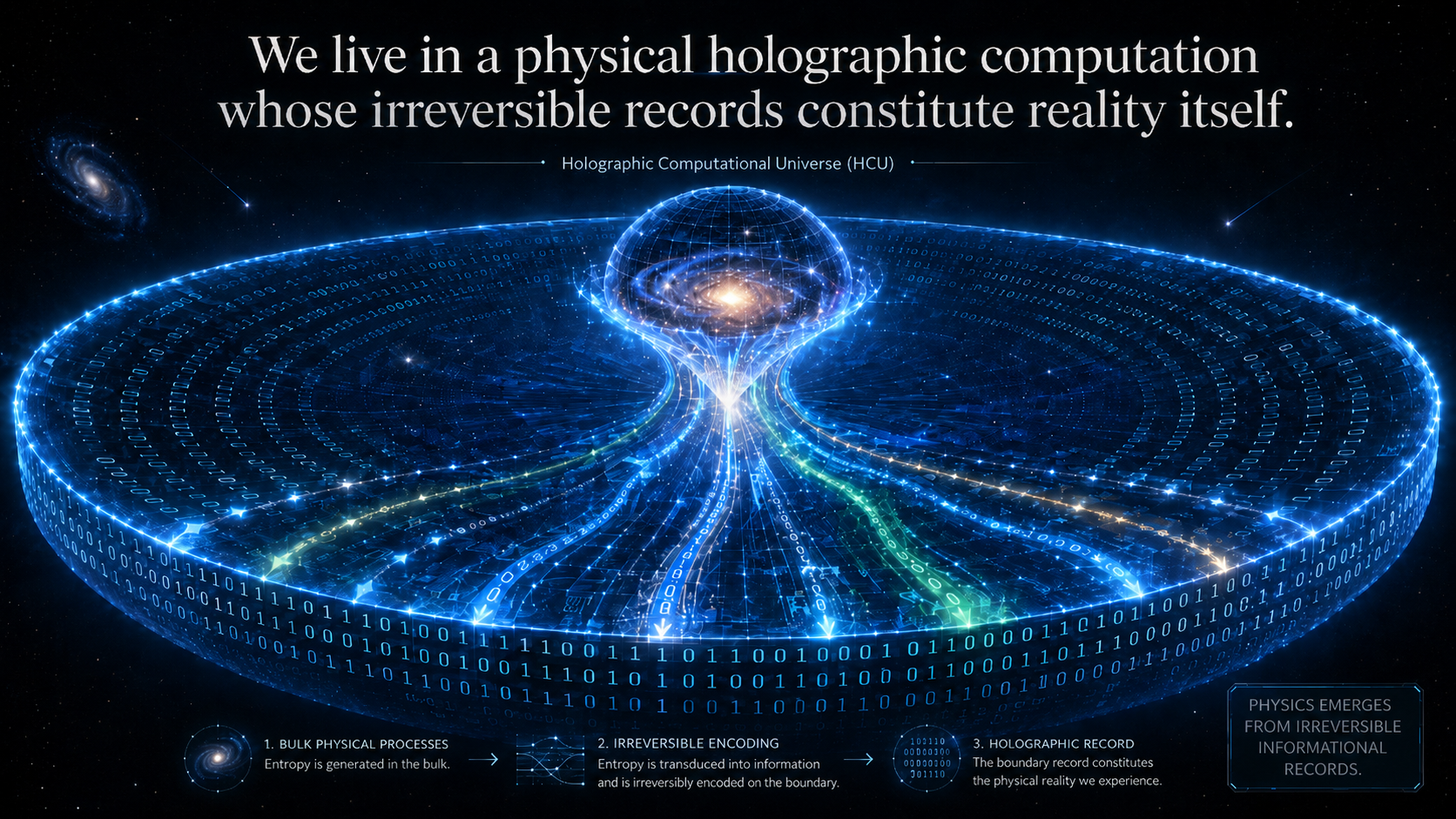
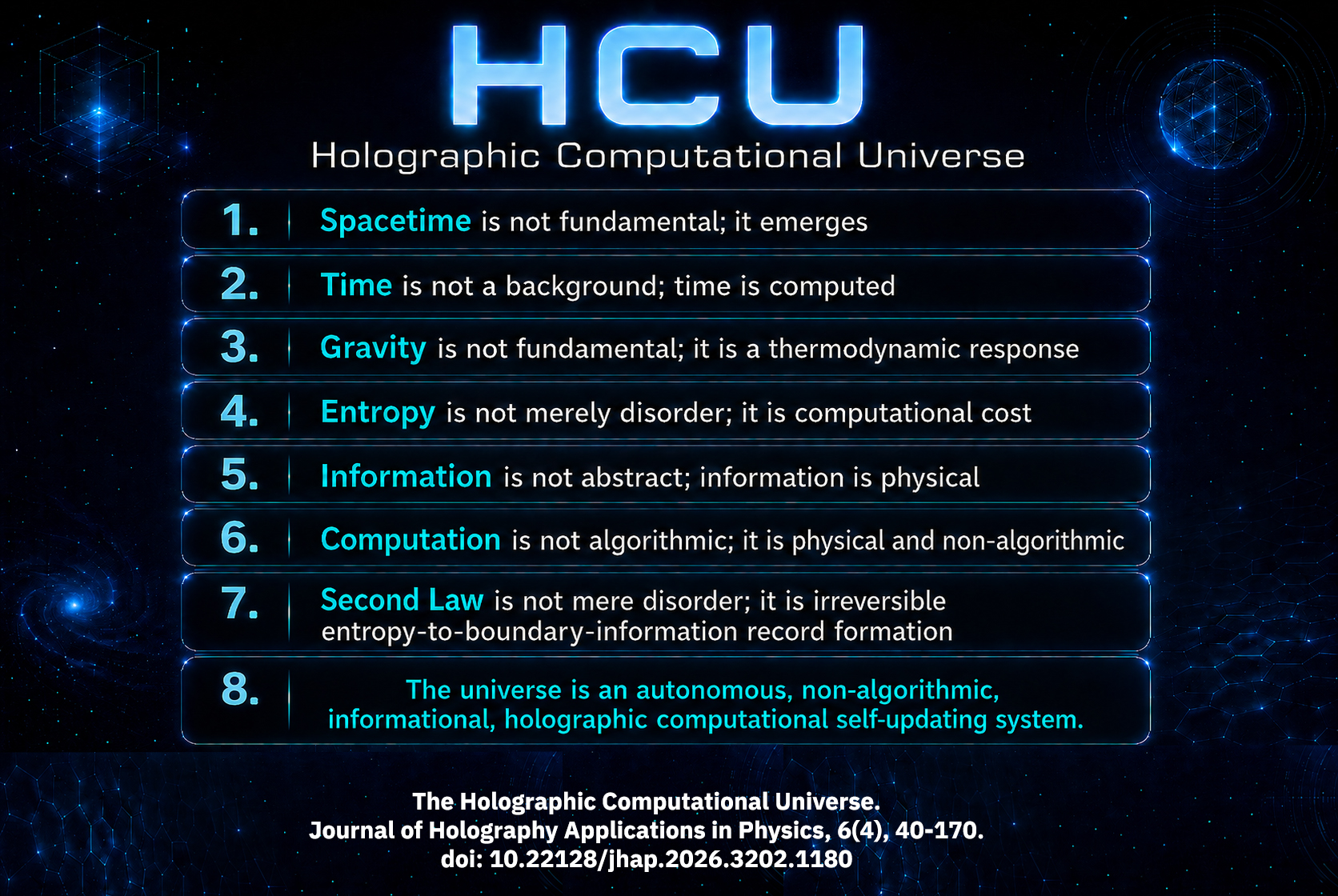
This image summarizes the central vision of the Holographic Computational Universe (HCU): reality is not a passive stage made of fundamental spacetime, but a self-updating physical process in which entropy, information, geometry, time, and gravity are dynamically connected.
In HCU, spacetime emerges, time is generated through irreversible informational updates, and gravity appears as a thermodynamic response to entropy–information gradients. Entropy is not treated merely as disorder, but as the physical cost of irreversible record formation. Information is not abstract; it is physical, encoded across holographic boundary structures, and participates in the evolution of the cosmos.
HCU does not describe the universe as a digital simulation or external algorithm. Instead, it presents the universe as an autonomous Holographic Computer, a physical, non-algorithmic, informational, holographic self-updating system.
Through these seven principles, HCU offers a coherent framework for exploring holographic gravity, emergent spacetime, quantum information, thermodynamics, cosmology, and the deep informational structure of reality.
Holographic Computational Universe and Known Theories
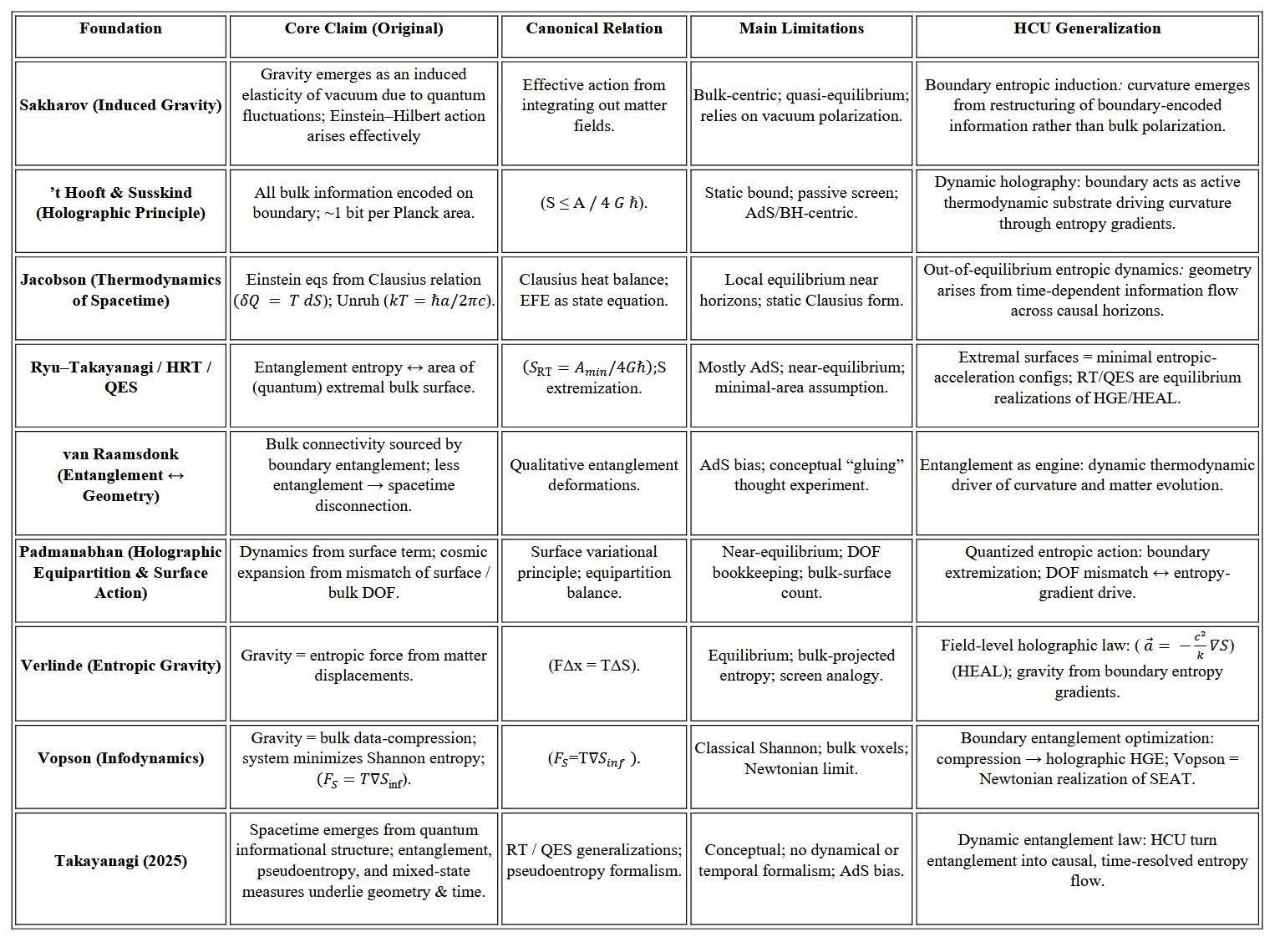
The Holographic Computational Universe (HCU) is a theoretical framework that connects holographic gravity, black hole thermodynamics, quantum information theory, Landauer physics, entropy-area scaling, and emergent gravity. HCU builds on established ideas in modern theoretical physics, but it is not simply an amalgamation of known theories. It reorganizes these concepts into a new dynamical framework centered on irreversible entropy-to-boundary-information transduction.
In the HCU framework, physical reality is generated through persistent holographic records. Bulk entropy is transformed into boundary-encoded information, producing a record-forming process that gives rise to emergent spacetime, the flow of time, and the thermodynamic emergence of gravity. Entropy is therefore not interpreted only as disorder; it becomes the physical cost of creating stable informational records within the evolving structure of the universe.
HCU also introduces the concept of the universe as a physical, non-algorithmic Holographic Computer. This does not mean that reality is a digital simulation or an external program. Instead, the universe is understood as an autonomous, self-updating informational system in which entropy becomes information, information becomes geometry, and geometry records the physical evolution of the cosmos.
In this sense, the Holographic Computational Universe is a theoretical synthesis with a distinct organizing principle. It draws from holography, thermodynamics, quantum information, black hole physics, and emergent gravity, while reframing spacetime, time, gravity, and cosmology through the central mechanism of irreversible holographic record formation.
Contemporary Approaches to Quantum Gravity and HCU
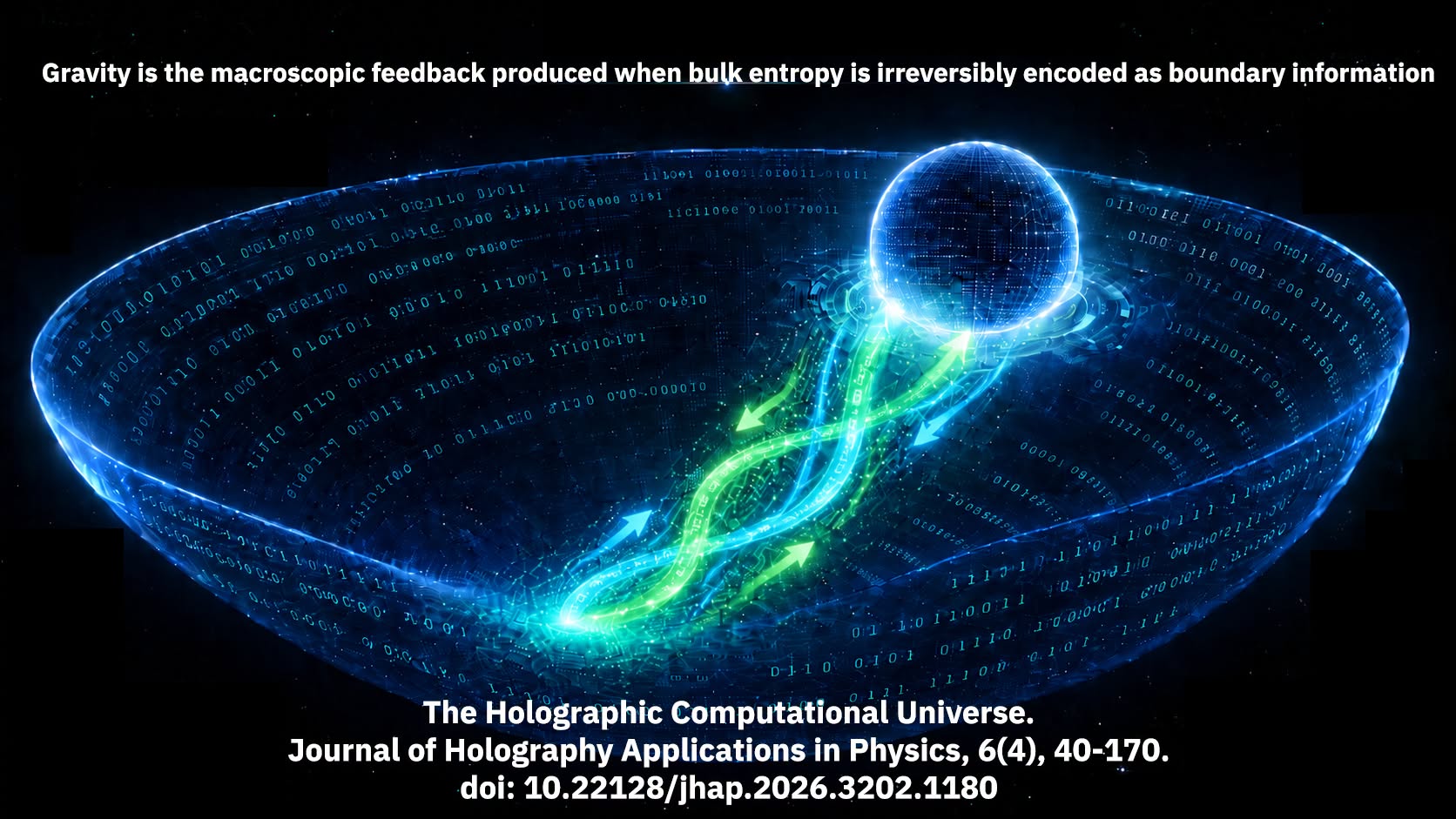
Where Boundaries Shape Reality is the central idea behind the Holographic Computational Universe. In this framework, physical reality is not understood as a passive three-dimensional stage, but as a dynamic holographic process in which entropy, information, gravity, and spacetime are deeply connected.
Holographic Gravity proposes that the boundary of a physical system is not merely a mathematical surface. It is an active informational interface where the structure of the bulk becomes encoded, conserved, and updated. Through irreversible entropy-to-boundary-information transduction, physical events become persistent holographic records. These records form the evolving memory structure of spacetime itself.
The Holographic Computational Universe builds on established ideas from holography, black-hole thermodynamics, quantum information, entanglement entropy, the entropy–area relation, and emergent gravity. Its originality lies in reorganizing these pillars into a unified dynamical framework centered on boundary encoding. Gravity then appears not as a fundamental force in isolation, but as the macroscopic response of spacetime geometry to entropy–information gradients.
In this view, boundaries do not simply contain reality. They participate in producing it. They encode the informational content of physical systems, regulate the relation between entropy and geometry, and preserve the irreversible records through which the universe acquires history. Spacetime becomes a holographic memory structure, continuously updated as entropy is transformed into information.
This is why the Holographic Computational Universe can be described as a physical, non-algorithmic holographic computation: the universe does not run as a digital simulation inside an external machine. Instead, it computes itself through real thermodynamic processes, boundary information encoding, and irreversible record formation.
Holographic Computational Universe:
Where boundaries shape reality through irreversible entropy-to-boundary-information holographic transduction.
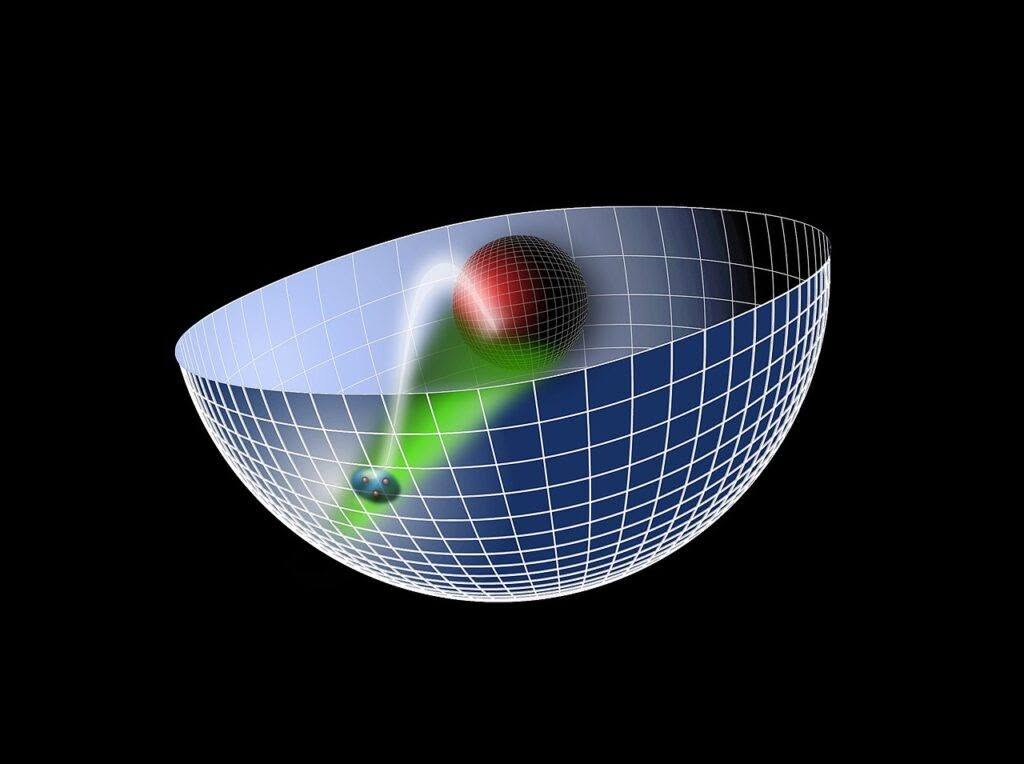
Discover the foundations of Holographic Gravity, a scientific framework exploring how gravity, spacetime, entropy, and quantum information may emerge from holographic boundary dynamics. Within the Holographic Computational Universe, physical reality is understood as a self-updating informational structure, where bulk entropy is transformed into boundary information through irreversible holographic transduction.
This approach connects black hole thermodynamics, the holographic principle, entropy–area relations, quantum entanglement, and emergent spacetime into a unified vision of gravity. Instead of treating spacetime as a fixed background, Holographic Gravity describes it as a dynamic memory structure shaped by entropy, information, and boundary encoding.
At its core, Holographic Gravity proposes that boundaries do not merely contain physical systems; they actively encode and organize reality. Through entropy–information holographic transduction, the universe preserves physical history, generates spacetime structure, and gives gravity its macroscopic thermodynamic meaning.
Holographic Computational Universe
Where Boundaries shape Reality