
In press in JHAP, Holographic Computational Universe proposes time, gravity, and spacetime emerge from entropy-to-information dynamics.
What if the universe is not built on matter first, nor on geometry first, but on a deeper process in which entropy is continuously converted into information, and information into physical structure?
This is the central idea of my new article, The Holographic Computational Universe, now in press in the Journal of Holography Applications in Physics. In this work, I propose a unified framework in which time, spacetime, gravity, and matter are not primitive ingredients of reality, but emergent consequences of a deeper thermodynamic-informational process operating through holographic boundaries.
At the heart of the framework is a simple but radical shift in perspective: the universe is not a static arena in which events unfold. It is a self-updating physical system. Reality is continually renewed through the quantized and conserved transduction of bulk entropy into boundary information, governed by what I call the Holographic Thermodynamic Cycle (HTC). In the article, this cycle is presented as an eight-phase renewal mechanism that maintains global informational balance while driving the ongoing evolution of the universe.
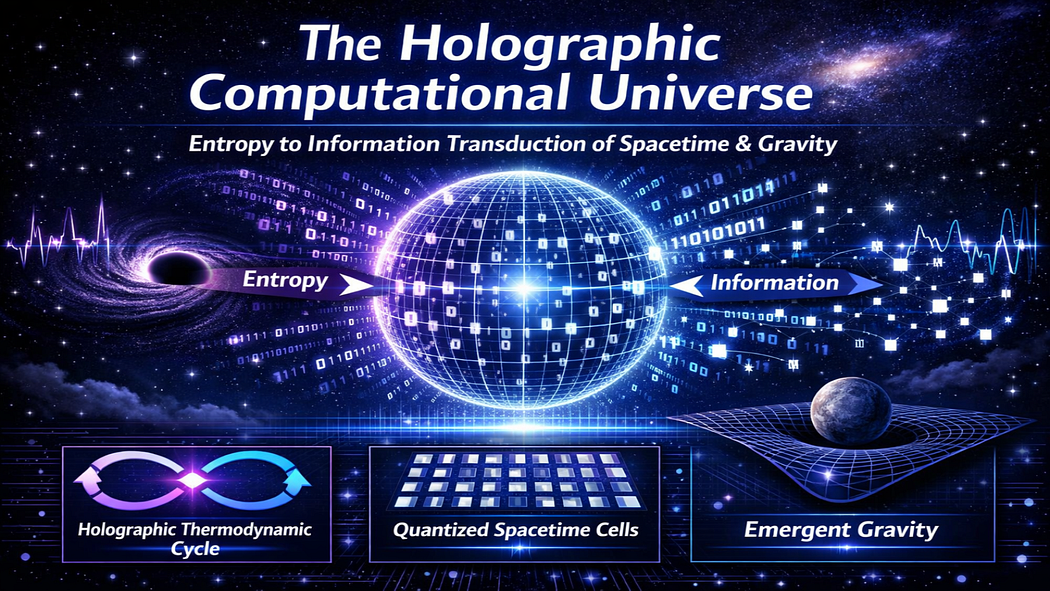
Within this picture, space is no longer an absolute background. It becomes a relational informational structure composed of Rindler–Compton cells, the elementary units of the holographic fabric. Each of these cells encodes one natural unit of information, and the sequential activation of these cells gives a microscopic account of how spacetime itself is generated and renewed. This means that spacetime is not merely “there”; it is continuously produced through quantized informational processes.
The framework also proposes a new understanding of time. Time is not treated as an independent external parameter flowing in the background. Instead, it emerges from the ordered succession of discrete informational updates called Quantum Informational Ticks (QITs). Their rate is set by the Quantum Informational Frequency (QIF),
ν_T=kT/h,
while the corresponding minimal temporal interval is
τ_T=h/kT.
In physical terms, each tick marks one elementary act by which entropy emitted from the bulk is encoded as information on the boundary. In this framework, temporal flow is the sequential order of these irreversible holographic updates.
This leads naturally to a different account of the arrow of time. Time’s direction does not arise merely from subjective perception or from coarse-grained statistical arguments. It arises because the universe persistently computes and records its own structure. The monotonic accumulation of boundary information gives a physical basis for irreversibility. In that sense, the passage of time is linked directly to the continual growth of informational structure.
The same logic is extended to gravity. In the HCU framework, gravity is not interpreted as a fundamental interaction in the conventional sense. It is the thermodynamic response to informational disequilibrium. Curvature emerges from entropy gradients across holographic boundaries. Stated differently, geometry is not primary; geometry is the macroscopic expression of underlying informational dynamics. This places gravity, thermodynamics, holography, and information theory inside one common physical architecture.
A crucial aspect of the article is that it does not stop at philosophical language. It develops a structured hierarchy of laws and principles, including Dynamic Entropy (DE), Holographic Entropy Flow (HEF), Holographic Information Flow (HIF), the Holographic Complementarity Relation (HCR), the Holographic Equilibrium Principle (HEP), and the Holographic Conservation Law (HCL). Together, these express a single underlying idea: what is lost as entropy in the bulk is gained as information on the boundary. The framework therefore extends Landauer’s principle into a universal holographic setting.
The article also connects this general structure to gravitational entropy, black-hole thermodynamics, and a generalized holographic description that goes beyond the narrow scope of highly symmetric AdS settings. One of its broader ambitions is to help move holography from a restricted correspondence into a more universal physical principle applicable to real gravitational systems. In that sense, the HCU is positioned not as a rejection of major previous developments, but as an attempt to integrate and extend them within a common informational framework. The manuscript explicitly situates itself in relation to Wheeler, de Broglie, Bekenstein, Hawking, ’t Hooft, Susskind, Jacobson, van Raamsdonk, Padmanabhan, Verlinde, and Vopson.
Another important point is that the universe, in this framework, is described as computational, but not in the narrow algorithmic sense usually associated with digital simulation. The article explicitly argues that the universe does not “run a program” like an external symbolic machine. Rather, it computes itself intrinsically through physical entropy–information transduction. This is why the framework refers to a non-algorithmic holographic computation: reality is generated through thermodynamic-informational operations, not through abstract code executed inside a pre-existing spacetime.
For me, this is one of the most important conceptual consequences of the work. If the HCU framework is on the right track, then time is not merely something measured by clocks, gravity is not merely a geometric curvature passively described by equations, and spacetime is not merely a container for physical objects. Instead, all three emerge from a deeper process of holographic informational renewal.
The article also emphasizes experimental relevance. It proposes falsifiable directions, including predicted limits related to entropy-processing rates and departures from standard Landauer behavior under specific conditions. In other words, the framework is not intended as pure metaphysics. It is presented as a coherent physical model with empirical stakes.
The Holographic Computational Universe was received on December 25, 2025, revised on January 8, 2026, and accepted on February 21, 2026, and is now in press in the Journal of Holography Applications in Physics.