
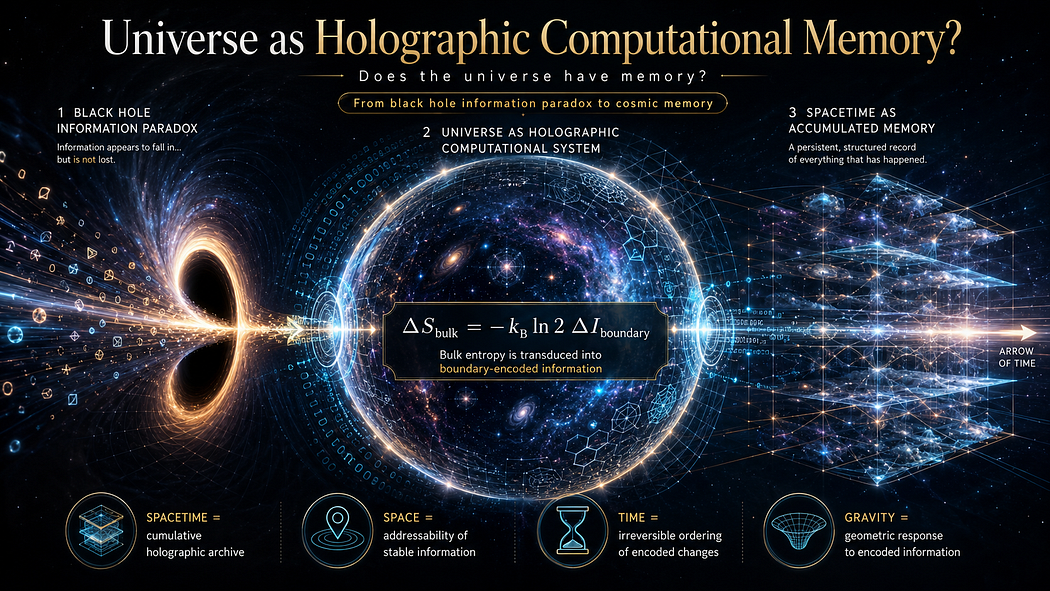
Does the universe have memory?
At first, the question sounds almost philosophical. Yet in modern physics, it can be reformulated more precisely: can physical information ever be truly lost, or is it always conserved, transformed, and re-encoded in the structure of reality?
This question became famous through the black hole information paradox.
Stephen Hawking originally argued that when matter falls into a black hole, the information describing that matter could disappear when the black hole evaporates through Hawking radiation. Leonard Susskind, following the principles of quantum mechanics and the holographic insight developed by Gerard ’t Hooft, defended the opposite view: information must be preserved, even in black holes.
The holographic principle offered a radical possibility. The information contained in a physical volume may be encoded on a lower-dimensional boundary. In the case of a black hole, the information about what falls inside may be preserved on the event horizon rather than lost in the interior.
This leads to a broader question:
If information is conserved, and if holographic encoding is physically real, could the universe itself possess a form of holographic memory?
Within the Holographic Computational Universe framework, my answer is yes.
But this memory is not psychological memory. The universe does not remember like a human mind. It remembers because physical processes leave persistent holographic records. In HCU, spacetime is not merely a passive stage on which events occur. Spacetime is the cumulative memory structure produced by irreversible informational encoding.
The key mechanism is expressed through the Holographic Conservation Law:
ΔS_bulk = − k ln 2 ΔI_boundary
This relation states that a change in bulk entropy is matched by an opposite change in boundary information. In words:
bulk entropy is transduced into boundary-encoded information.
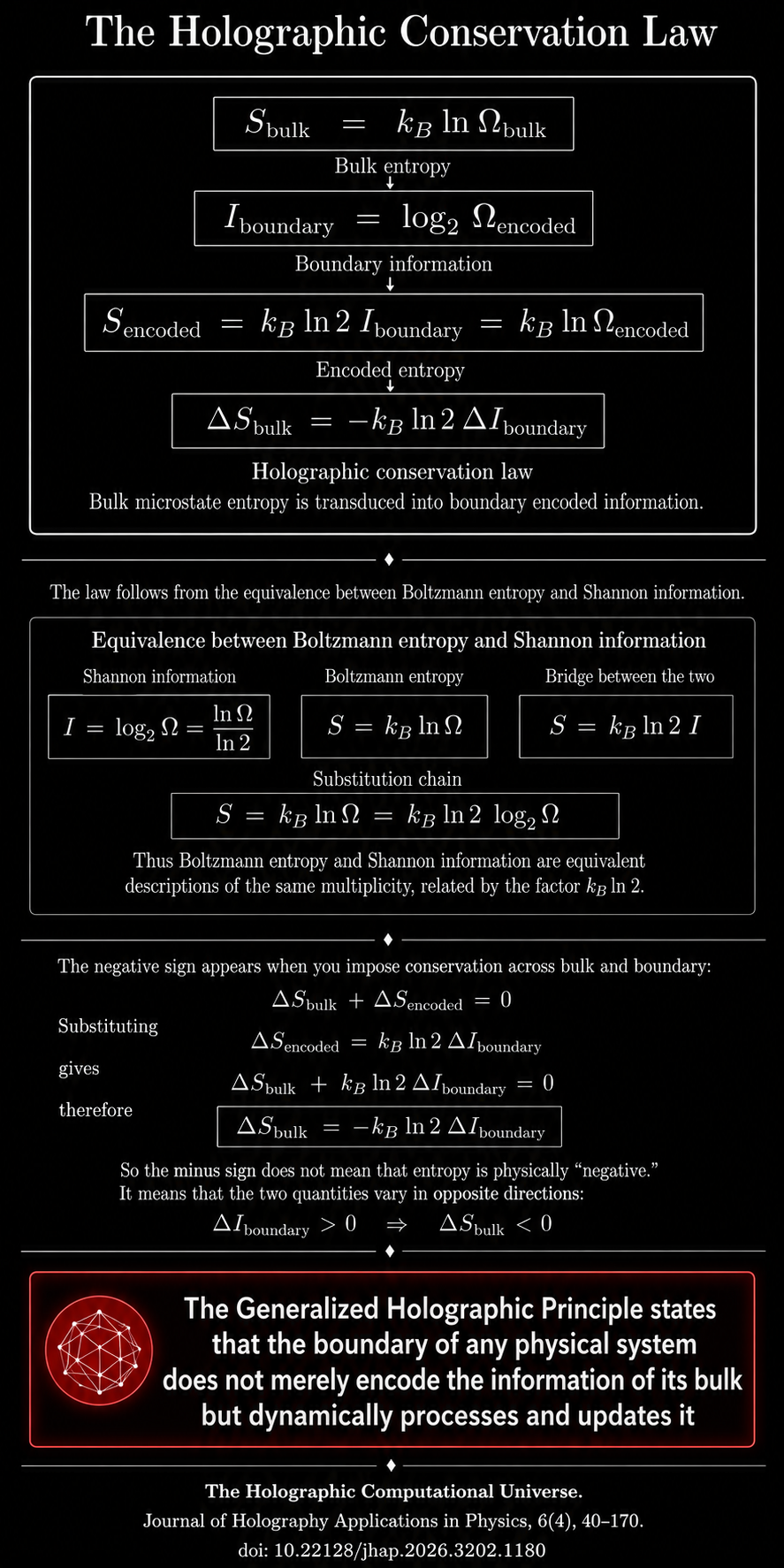
The starting point is the equivalence between Boltzmann entropy and Shannon information. Boltzmann entropy describes the number of possible physical microstates of a system. Shannon information describes the number of bits required to specify a state among possible alternatives. These are not unrelated concepts. They are two descriptions of the same multiplicity: one thermodynamic, the other informational.
This means that entropy and information are connected by the factor k ln 2. Entropy measures the thermodynamic multiplicity of possible states; information measures the number of binary distinctions needed to specify them.
HCU uses this equivalence to formulate a holographic conservation relation between bulk entropy and boundary information.
The minus sign is important.
It does not mean that entropy becomes physically negative. It means that the two quantities vary in opposite directions. When boundary information increases, the corresponding bulk entropy decreases in that transduction channel. The minus sign is therefore an orientation marker: it expresses conservation across the bulk-boundary relation.
In HCU, this is the basis of universal memory.
The universe remembers because entropy is not simply lost. It is converted into boundary information. What appears as unresolved bulk multiplicity becomes encoded, structured, and preserved as holographic information.
This is why, in HCU, physical reality is not merely the motion of objects through spacetime. It is the continuous conversion of entropy into boundary-encoded information.
Each physical process contributes to a growing holographic archive. This archive is what we experience as spacetime.
In standard physics, spacetime is often treated as the stage on which physical processes occur. In HCU, spacetime is not fundamental in that passive sense. It is the persistent memory structure generated by holographic encoding.
Space corresponds to the addressability of stable information.
Time corresponds to the irreversible ordering of encoded changes.
Gravity corresponds to the macroscopic thermodynamic response of geometry to this encoded informational structure.
This also explains why the past is not simply “gone.” In HCU, the past is the already-written informational structure of spacetime. To change the past would require erasing or rewriting completed holographic records. Such rewriting would not be thermodynamically free. It would require compensating entropy production elsewhere.
This is why the arrow of time is linked to memory.
Time flows because the universe keeps updating its holographic record.
The standard holographic principle suggests that the information contained in a volume can be encoded on a boundary. HCU generalizes this idea through the Generalized Holographic Principle:
the boundary of any physical system does not merely encode the information of its bulk, but dynamically processes and updates it.
This is a crucial extension.
The boundary is not a passive storage screen. It is an active informational interface. It receives, encodes, processes, updates, and stabilizes the informational structure of the system.
The universe has memory because physical processes become holographically encoded.
The universe remembers because entropy is transduced into boundary information.
The universe remembers because spacetime is the accumulated archive of encoded physical history.
And this memory is holographic because the information of the bulk is conserved, encoded, and dynamically updated through boundary structures.
The black hole information paradox showed that information cannot be casually dismissed as lost. The holographic principle showed that information may be encoded on boundaries rather than stored in volumes. HCU extends this logic to physical reality as a whole.
The universe does not simply contain memory.
The universe is memory: holographically written, thermodynamically conserved, and continuously updated through the transformation of entropy into boundary information.
Based on :
The Holographic Computational Universe.
Journal of Holography Applications in Physics, 6(4), 40–170.
https://doi.org/10.22128/jhap.2026.3202.1180